The viral video funnel — angles, hooks & awareness
Short-form that converts isn't luck — it's a funnel: awareness stage → angle → hook → format → recut → publish. Learn the vocabulary, then run the whole thing by chatting, and you can make ads on purpose.
Key takeaways
- Every winning short is an awareness stage → angle → hook → format → recut stack.
- Awareness stage (Eugene Schwartz) is where the viewer's head is at before they hit play.
- The angle is your persuasive framing; the hook is the first 1–3 seconds that stop the scroll.
- You pour that angle+hook into a proven format you fork — never a blank timeline.
- Each funnel layer maps 1:1 to a brainstorm primitive — and VidFarm's Chat runs it for you from one product description.
Why a funnel at all?
A viral format is a container. The same meme-caption or product-tease structure can sell a skincare serum, a B2B SaaS, or a mobile game — but only if you pour the right message into it. The funnel is how you decide what that message is, layer by layer, before you ever open the editor.
VidFarm treats this as real vocabulary, not vibes. When you say "give me hooks" or "which awareness stage should I target," the AI doesn't riff from memory — it calls a dedicated brainstorm primitive for that exact layer of the funnel. Learn the six layers below, and the second half of this chapter runs every one of them for you from a single input: your product description.
Eugene SchwartzLayer 1 — Awareness stage
Before a viewer meets your product, they're standing on one rung of Eugene Schwartz's awareness ladder. The same offer needs a completely different ad depending on the rung. Target the wrong one and even a perfect hook falls flat.
- Problem-unaware — they don't even know they have the problem yet. Lead with the pain, not the product.
- Problem-aware — they feel the pain but don't know solutions exist. Agitate and hint at a way out.
- Solution-aware — they know solutions like yours exist, but not your product. Differentiate.
- Product-aware — they know your product; they need a reason to act now. Offer, proof, urgency.
- Most-aware — they're ready; just make the deal obvious.
- UnawareDoesn't know they have the problem.
- Problem-awareFeels the pain, not the fix.
- Solution-awareKnows fixes exist, not yours.
- Product-awareKnows you, not convinced.
- Most awareReady — just needs the offer.
awareness_stages primitive will tell you which stage to lead with, and flag when you should just test them all.The persuasive framingLayer 2 — Angle
An angle is the specific promise or story you tell at a given awareness stage. "Save 6 hours a week" and "Never look disorganized in front of your boss again" are two angles on the same product — one functional, one emotional. One plain product, refracted through the right angle, fans out into many distinct, valuable ways to sell it.

Angles depend on two flags you fix first: a problem_awareness value (either problem_unaware or problem_aware) and a solution_awareness value (either solution_unaware or solution_aware). Those four exact strings are the only accepted values — they pin the angle generator to the rung you chose in Layer 1.
The first 1–3 secondsLayer 3 — Hook
The hook is the opening line or frame that stops the thumb mid-scroll. It's TikTok-native — a bold claim, a pattern interrupt, a question, a "wait for it." A great angle with a weak hook never gets watched; the hook is what earns the right to the rest of the video.

Where the funnel meets the editorLayers 4–6 — Format, recut, publish
Now you pour the angle+hook into a proven format. That's what the Discover feed and Categories are: a library of short-form structures that already worked. You fork one, then recut it — swap its captions and media so the format becomes your ad. If you're borrowing a competitor's video, the product_placement primitive finds the exact timestamps where your product fits natively inside their structure.

Finally you publish and test: render, approve into a shareable post, schedule it — and, because you speak the funnel, spin up variants that test different awareness stages and angles against each other.
Hands-on walkthroughRun the whole funnel by chatting
That's the map. Now run it. Everything starts from a single input — your product description — and Chat walks it down every layer: which awareness stage to target, what angles fit, and the exact hooks to open with.
The trick is that VidFarm's Chat isn't a generic chatbot. When you ask for hooks, angles, awareness stages, or a cold-start plan, it calls the dedicated brainstorm primitive for that layer immediately — real, structured reasoning, not a paragraph pulled from memory.
-
Set your product description first
Every brainstorm reads one shared input. Open Settings → Profile , fill the Product description field — what it is, who it's for, the promise — and click Save changes. Be specific; this is the signal the AI tailors everything to.
-
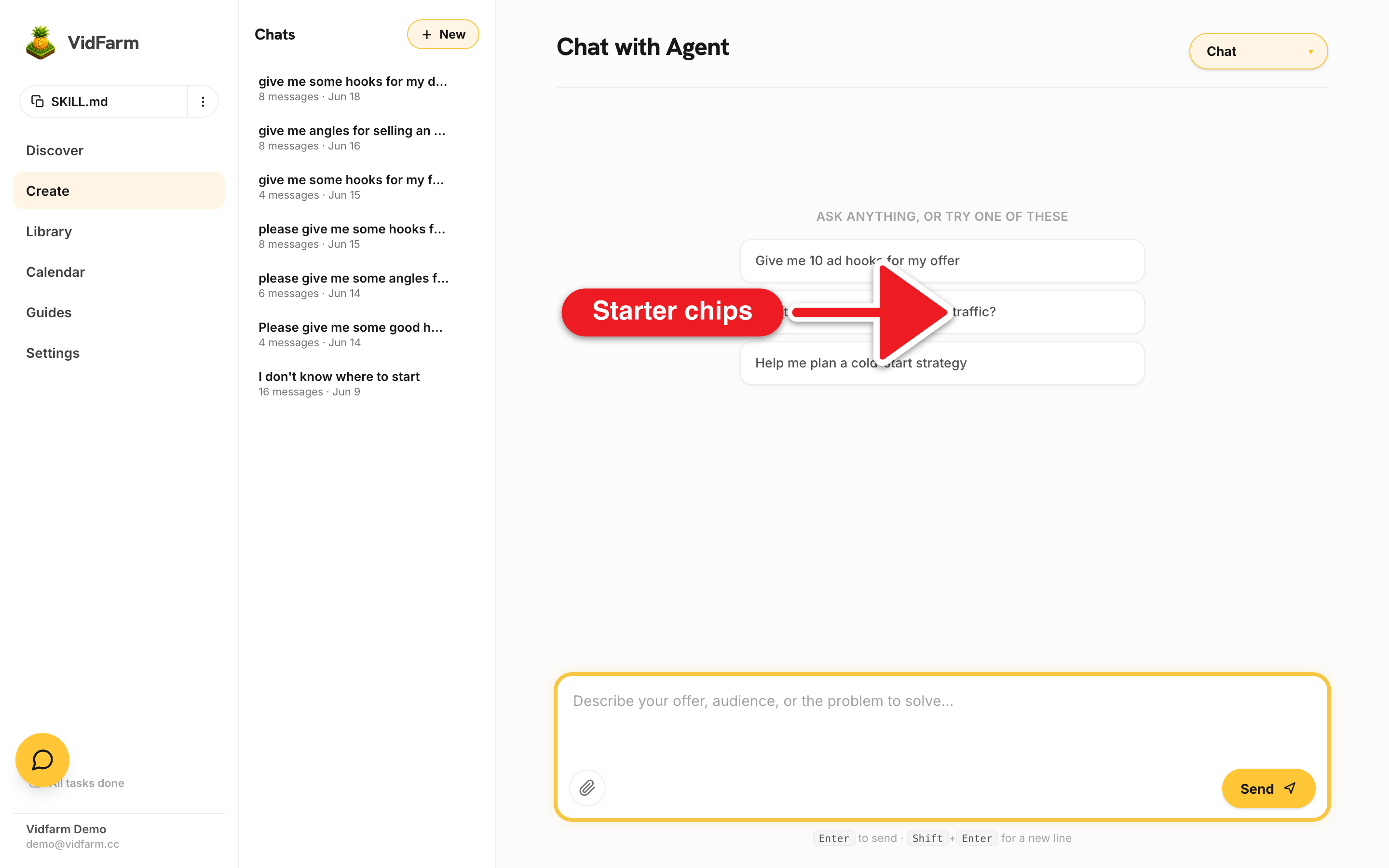
Open Chat and pick a starter chip
Head to Chat . The empty state hints "Ask anything, or try one of these" with three chips: "Give me 10 ad hooks for my offer," "What angle works best for cold traffic?," and "Help me plan a cold-start strategy." These are the funnel layers as one-click prompts.
-
Pick the awareness stage to target (Layer 1)
Ask: "Which awareness stage should I target first for my offer?" Chat runs the
awareness_stagesprimitive and returns the recommended Eugene-Schwartz stage — or tells you to make and test ads for every level if it's genuinely unclear. -
Generate angles for that stage (Layer 2)
Follow up: "Give me angles for problem-aware, solution-unaware buyers." Chat runs the
anglesprimitive. Behind the scenes it needs aproblem_awarenessvalue (problem_unawareorproblem_aware) and asolution_awarenessvalue (solution_unawareorsolution_aware) — naming the pair in plain English pins it correctly. -
Write the hooks (Layer 3)
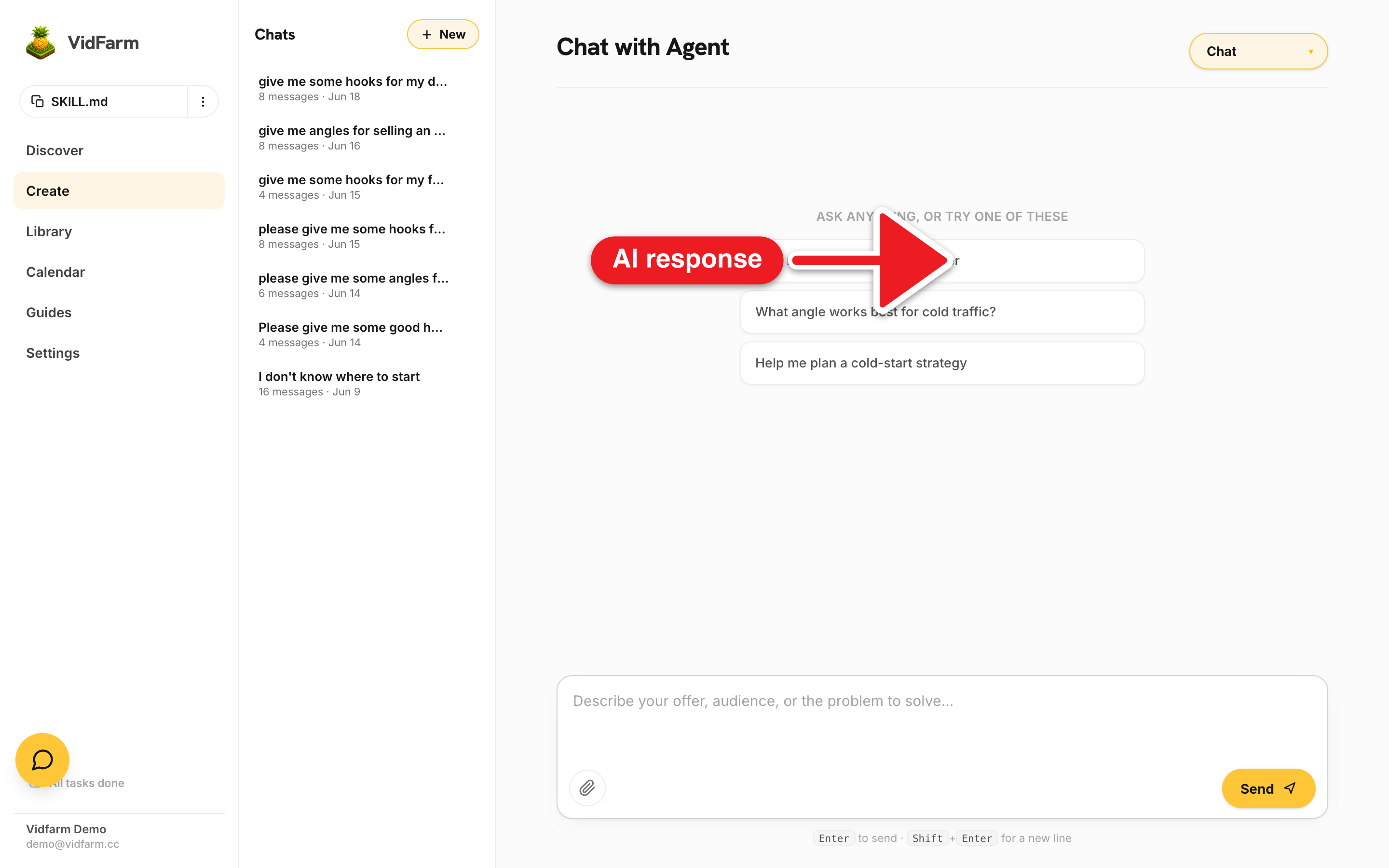
Click the "Give me 10 ad hooks for my offer" chip, or ask for hooks per angle. Chat runs the
hooksprimitive and returns TikTok-native openings you can drop straight into a template's first caption. -
Save each result to My Files
Ask Chat to "save these as awareness-levels.md, persuasive-angles.md, and ad-hooks.md in My Files under my offer folder." Namescoping them under the offer folder means every future chat or agent can read your strategy back instead of re-deriving it.
/chat is a paid brainstorm surface — free accounts see the "AI Studio" upgrade gate. The lighter global chat dock at the bottom of any page still works on the free tier for quick questions. More in Free vs paid & BYOK perks .Where to go next
You've got an awareness stage, angles, and hooks on file. Now pour them into a proven format — either a template you fork, or a competitor's whole structure:
You now speak the funnel
Awareness → angle → hook → format → recut → publish. Every VidFarm brainstorm primitive is one of these layers. Open Chat, run the chips against your offer, and hand the best hook straight to a forked template.
Open Chat